Why We Built BidsFactory: Turning a Fragmented Tender Market into a Single View
Every platform Aninver builds starts the same way: with a problem we keep running into across the markets where we work. BidsFactory began with one we could no longer ignore.
The problem we kept seeing
For years, advising governments, development finance institutions and private clients on infrastructure and private-sector development, we watched the same pattern repeat. The capacity to deliver was rarely the binding constraint for emerging-market firms. The capacity to find and compete for the right opportunities almost always was.
The reason is structural. There is no single place where the world's development and government contracts are published. The World Bank, the African Development Bank, the Asian Development Bank, the EBRD and the Inter-American Development Bank each run their own notice systems. Bilateral donors and UN agencies add more. And national procurement—the largest layer of all—is the most fragmented: a single country may scatter its opportunities across a federal bulletin, dozens of regional systems, and separate platforms for health, energy or transport, each with its own login, language and format.
The notices exist. They are simply impossible to monitor in full. Large international contractors solve this by spending money—dedicated business-development teams and paid agents who watch the right portals. The firms that cannot absorb that cost are precisely the ones development finance most wants to include: local SMEs, first-time bidders, women-led and rural enterprises. Fragmentation, in effect, is a regressive filter that rewards incumbents and penalises newcomers.
We decided to build the tool we wished our clients had.
What BidsFactory does
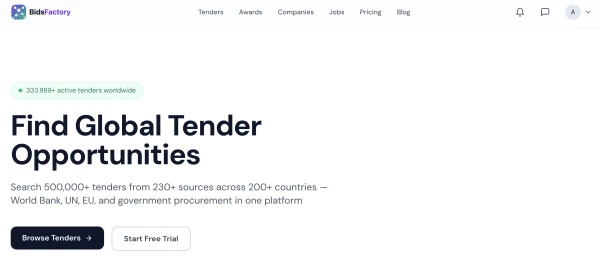
BidsFactory consolidates more than two million public tenders and contract awards from hundreds of official sources—multilateral development banks, bilateral donors, and national and sub-national procurement portals across dozens of countries—into a single, structured, searchable platform.
Three design choices matter most:
- Aggregation over silos. Opportunities that once sat behind dozens of separate logins are pulled into one place and updated continuously, so a firm monitors one feed instead of a hundred.
- A common working language. Notices are translated into English, so a Spanish-language opportunity in Latin America is legible to a bidder in West Africa, and a Japanese or Polish notice is no longer a dead end for an international consultant.
- Structure you can filter. Every notice is normalised into a consistent taxonomy—country, sector, contract type, deadline, buyer—turning a chaotic stream of raw notices into something you can actually search and act on.
The result is that discovery stops being a function of how many portals a firm can afford to watch, and starts being a function of capability. A small specialist with genuine expertise can compete on the merits of its offer rather than losing by default because it never saw the notice.
Why this is development work, not just a product
It would be easy to read BidsFactory as a business tool. We see it as something closer to our mission.
The procurement-reform agenda of the past two decades focused, rightly, on transparency—getting notices published and contract data opened. That work was necessary, but transparency and access are not the same thing. A notice that is technically public yet practically undiscoverable advances accountability without advancing participation.
BidsFactory is our contribution to the next frontier: access. Every additional qualified bidder who finds a relevant contract is a small gain in competition, in value for money, and in the share of public spending that reaches local firms and workers. Aggregated procurement data—who is buying what, where, and at what price—also becomes a strategic resource for market analysis, supplier development and policy design, rather than a compliance archive no one can read.
That is the same logic behind the rest of the Aninver ecosystem, from our infrastructure-finance intelligence to our sector advisory work: lower the barriers between capable firms and the opportunities they are equipped to win, and better development outcomes tend to follow.
Where we are headed
BidsFactory is live and growing—broadening its coverage of national systems, deepening the data behind every contract and award, and building the tools that turn raw notices into genuine market intelligence. The contracts are already out there. Our job, as ever, is to make sure the right firms can see them.
You can explore the platform at https://bidsfactory.com/en.
