Aninver Wins First Contract with CCCCC to Support GCF-Funded BaC-SuF Climate Resilience Project in Belize
Aninver has secured its first contract with CCCCC for Belize’s GCF-funded BaC-SuF project, covering vulnerability analysis, selection criteria, and M&E baselines.
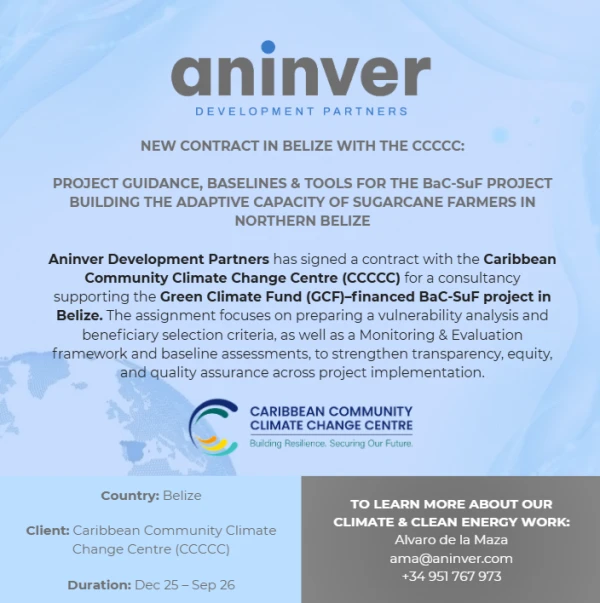
Aninver Development Partners is pleased to announce a new contract in Belize with the Caribbean Community Climate Change Centre (CCCCC), marking our first engagement with the Centre. The assignment supports the Green Climate Fund (GCF) project Building the Adaptive Capacity of Sugarcane Farmers in Northern Belize (BaC-SuF) and will be delivered over a 10-month period starting in September 2025. Through this engagement, we will help strengthen the project’s analytical and implementation foundations, contributing to a more transparent, evidence-based, and equitable approach to supporting smallholder sugarcane producers facing increasing climate risks in northern Belize.
A Regional Climate Institution Supporting Country Action
CCCCC has a mandate to coordinate CARICOM’s response to climate change and provide climate-related policy advice and guidance to CARICOM Member States. The Centre is also an accredited regional implementing entity of the Green Climate Fund, enabling it to mobilize and manage climate finance for priority investments across the region.
Project Context: Building Adaptive Capacity in Northern Belize
BaC-SuF was developed to address the physical, financial, and institutional dimensions of climate vulnerability faced by sugarcane farmers in northern Belize. The project combines field-level resilience measures—such as improved climate-adapted varieties and climate-smart practices—with investments in knowledge systems that help farmers and institutions sustain and scale change over time.
Scope of Services: Evidence, Criteria, and Measurable Results
Under this contract, Aninver will work with CCCCC and project partners to deliver three closely linked outputs.
First, we will conduct a vulnerability analysis of the Northern Belize sugarcane industry, combining biophysical and social vulnerability dimensions and integrating stakeholder perspectives to build a practical profile of “who is most at risk, and why.”
Second, we will develop eligibility and selection criteria for beneficiary farmers, using the vulnerability findings to help guide equitable targeting and transparent decision-making.
Third, we will design a Monitoring & Evaluation (M&E/MEL) Framework and Plan, including KPIs/KSIs and—where baseline data is missing—baseline assessments to ensure progress and impact can be measured consistently throughout implementation.
Stakeholder Validation as a Quality Standard
A key feature of the assignment is structured stakeholder validation: results and criteria will be presented to stakeholders identified by CCCCC and the Project Steering Committee to capture feedback, strengthen legitimacy, and improve practical usability.
Aninver’s Role and Vision
This new engagement also reflects Aninver’s continued work in Belize. It is our third consecutive assignment in the country, following recent projects delivered for the Inter-American Development Bank and UNIDO, reinforcing our commitment to climate resilience and inclusive, results-driven programming across the Caribbean.
